
.png?width=1200&height=623&name=GRI%20102%20Case%20Study%20%20(4).png)
Industry
Energy
Challenge
Ensuring accurate and timely data collection across remote and critical infrastructure (solar plants, desalination facilities, and transmission networks).
Results
Reduced operational emissions, improved renewable energy integration, enhanced climate resilience, and more consistent and reliable sustainability reporting.
About DEWA
Dubai Electricity and Water Authority (DEWA) is the exclusive provider of electricity and
water in Dubai, UAE, serving more than 1,327,182 million customers. The company’s
installed generation capacity stands at 17,979 Megawatts (MW) of electricity – of which
3,860MW comes from clean sources – and 555 million imperial gallons of desalinated
water per day, in a context defined by water scarcity, extreme heat, and rapid urban growth.
DEWA is a long-standing sustainability reporter, publishing in accordance with the GRI
Standards and supporting the transparent disclosure of environmental, social, and
economic performance. Its reporting aligns with national and local strategies, including the
UAE Net Zero 2050 Strategy, the Dubai Clean Energy Strategy 2050, and the Dubai Net
Zero Carbon Emissions Strategy 2025.
DEWA’s most significant climate- and energy-related impacts relate to power generation, desalination, and network operations. These include greenhouse gas emissions, energy efficiency, water use, and resilience to extreme weather. To address these, DEWA has increasingly focused on integrating renewable energy, improving operational efficiency, and strengthening climate resilience across its infrastructure.
DEWA's reporting background
DEWA has reported using the GRI Standards since 2013, building a structured approach to identifying, managing, and disclosing its climate and energy impacts. This includes long-standing reporting on energy (GRI 302: Energy 2016) and emissions (GRI 305: Emissions 2016), supported by internal systems and processes for data collection, validation, and reporting across operational units.
DEWA’s past reporting experience has helped strengthen its understanding of key impact areas, including energy intensity, emissions from power generation, and water-related impacts from desalination.
With this foundation, DEWA is preparing to align with the GRI 102: Climate Change and GRI 103: Energy Standards, published in 2025. In particular, existing practices around emissions monitoring, energy efficiency, and operational data integration are being expanded to support more comprehensive disclosures on climate-related impacts, transition planning, and mitigation actions.
DEWA’s use of the GRI Standards has also contributed to alignment with other frameworks and initiatives, including national climate targets and renewable energy expansion, supporting consistency across disclosure requirements.
The context
DEWA operates complex electricity and water infrastructure across a challenging environment. Managing climate-related risks and optimizing energy use requires reliable, real-time data across geographically dispersed assets.
To address this, DEWA launched the Space-D program in 2021, exploring how satellite and remote sensing technologies can enhance operational efficiency, resilience, and environmental performance. This initiative is increasingly relevant in the context of GRI 102 and 103, which require organizations to disclose how they manage climate-related impacts, improve energy performance, and support mitigation and adaptation efforts.
The challenge
A key challenge for DEWA is ensuring accurate and timely data collection across remote and critical infrastructure, including solar plants, desalination facilities, and transmission networks.
This affects:
- Monitoring of energy performance and efficiency
- Tracking of emissions and environmental impacts
- Management of risks from extreme weather and marine conditions
- Integration of renewable energy into the grid
Traditional monitoring approaches can be resource-intensive and may not provide the level of granularity or timeliness needed for effective, decision-useful reporting.
The Space-D program combines satellite data, IoT (Internet of Things) sensors, and analytics to enhance monitoring and decision-making. Initial use cases were developed through two nanosatellites:
| DEWASAT-1 (2022) | enabling IoT data collection from remote assets |
| DEWASAT-2 (2023) | supporting environmental monitoring, including greenhouse gases, salinity, and thermal data |
Satellite data is processed through DEWA’s ground-station infrastructure and integrated with operational systems using AI-enabled analytics and a private cloud environment. This enables near real-time data processing and secure sharing across business units.
Remote sensing data is consolidated through the Majara Geo-portal, which connects satellite insights with operational data from field assets. In parallel, in-house developed multi-connectivity terminals support the integration of satellite and terrestrial sensor data, particularly for remote or hard-to-access infrastructure.
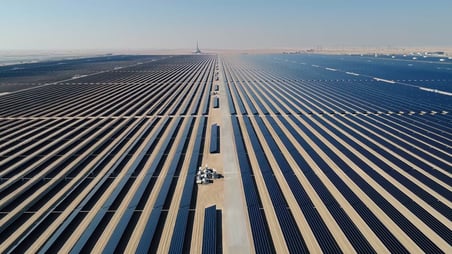
This integrated data architecture strengthens DEWA’s ability to generate consistent, decision-useful data for both operational management and sustainability reporting. Capabilities have also been expanded through additional satellite services and further integration into DEWA’s operational systems and digital platforms.
Key applications and benefits include:
- Energy optimization: solar irradiance and fog forecasting to improve reserve management, support renewable integration, and reduce fuel consumption
- Grid reliability: remote monitoring of substations to reduce site visits and maintenance needs
- Water security: early detection of red tides and oil spills affecting desalination
- Environmental monitoring: tracking salinity, temperature, and fugitive emissions
From a GRI reporting perspective, these systems support:
- Improved data quality for disclosures under GRI 102 and 103
- Enhanced tracking of emissions and energy performance
- Better identification and management of climate-related risks and impacts
The approach
The use of remote sensing and digital monitoring has contributed to:
- reduced need for physical inspections, lowering operational emissions
- improved integration of renewable energy through better forecasting
- enhanced resilience to environmental and climate-related risks
- more consistent and reliable data for sustainability reporting
In addition, the ability to monitor environmental parameters such as seawater temperature, salinity, and emissions-related indicators provides more granular and verifiable data inputs for sustainability disclosures. This supports improved transparency and more robust decision-making aligned with GRI 102 and 103, particularly in relation to energy management, emissions, and climate adaptation.
Lessons learnt
Key factors supporting implementation include:
- early engagement of senior management
- collaboration with operational teams to identify relevant use cases
- an iterative approach, starting with pilot solutions and scaling over time
- investment in internal technical capabilities and data systems
At the same time, challenges remain in integrating new data streams, ensuring consistency across systems, and translating technical insights into reporting outputs aligned with evolving standards.
Conclusions
DEWA’s experience highlights important considerations for organisations looking to
strengthen climate and energy reporting in line with global best practice set out in GRI 102
and GRI 103.
Key conclusions are:
-
Investing in data systems and monitoring capabilities can significantly improve both
operational performance and the quality of disclosures, particularly for
organisations with complex or distributed assets. -
Starting with targeted pilot projects can help test new approaches and build internal
capacity before scaling solutions more broadly. -
Aligning technical initiatives with reporting requirements from the outset can
support more efficient implementation and ensure that data collected is directly
relevant for disclosures. -
Strong internal collaboration between sustainability, operations and technology
teams is essential to translate data into meaningful insights and reporting
outcomes.
While approaches will vary by sector and geography, DEWA’s experience demonstrates
how digital innovation can support more effective management of climate and energy
impacts, while strengthening transparency under the GRI Standards and preparing the
organisation for adoption of GRI 102 and 103 in future reporting cycles.
Ready to get started GRI 102?


.png?width=1500&height=1500&name=Copy%20of%20Copy%20of%20Untitled%20Design%20(4).png)